


The immediate costs of renewable energy – and the development needed to install it – can seem very high to some of the people affected. But the economic and societal benefits of the energy transition largely offset its initial investment costs. Switching to renewables does not only reduce the damage that fossil fuel extraction causes to water and biodiversity. A renewable energy supply also cuts air pollution and related health costs.
Renewable energy technologies are the essential technologies to fight the climate crisis as they can replace all fossil fuel supply. Renewable electricity can also substitute fossil fuel use for transport and heating with zero greenhouse gas emissions and much lower environmental impacts than fossil fuels. The immense societal costs caused by climate change, the health impacts of fossil fuel combustion and the risk of catastrophic nuclear accidents are often ignored in energy policy discussions, as they are less visible or immediate than impacts on energy prices.
More renewables protect our health and save lives
Europeans will experience extreme weather events such as heatwaves more often in a world that is currently heading towards an average global temperature increase of 3°C. The European Commission’s Joint Research Centre estimates that the mortality from extreme weather in the EU will rise to approximately 100,000 victims per year.
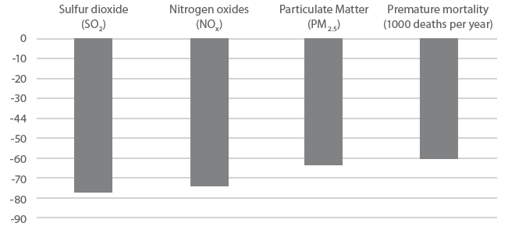
Projected decrease in air pollution (2015–2040; %); European Commission’s LIFE scenario
Source: European Commission: Securing our future. Europe’s 2040 climate target and path to climate neutrality by 2050 building a sustainable, just and prosperous society. Impact assessment report, SWD(2024) 63, February 2024, see Heinrich-Böll-Stiftung EU: 100% Renewable Energy Action Plan 2024.
Building a renewable energy system in the EU allows us to reduce greenhouse gas emissions by 90 percent by 2040. This would lead to a considerable drop in air pollution. According to EU projections, this would prevent more than 250,000 premature deaths and save over a trillion euros in health costs per year, with the primary driver being the switch away from combustion fuels to renewable energy sources. Moving to 100 percent renewables and electrifying all sectors will lead to even greater health benefits as polluting fossil power and heating plants, as well as combustion engines, are phased out.
Renewables are the key to save our natural ecosystems
The energy transition towards a more efficient and renewable system is key to protecting water resources, not only in arid regions. Thermal power plants like nuclear reactors and coal-fired power plants consume a lot of cooling water. The water removals for fossil and nuclear energy add strain to a water balance that is already under heavy pressure from the climate crisis.
Cooling for electricity generation is Europe’s largest water consumer
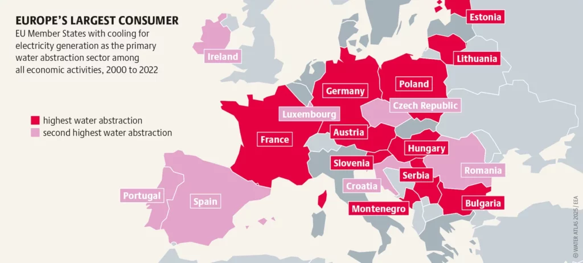
From 2000 to 2022, cooling power plants in the EU used 36 percent of total water abstraction, with shares varying by country. Source: Heinrich-Böll-Stiftung: Water Atlas 2025, credits: Eimermacher/stockmarpluswalter.
Extracting fossil fuels and uranium for nuclear power causes huge damage to ecosystems. It goes without saying that phasing out fossil fuel mining would also end water pollution and other harms.
Despite all the benefits of moving away from fossil fuels, the benefits are often not immediately apparent to everyone affected by the transition. Sometimes a community which was unaffected by fossil fuel infrastructure is asked to host new structures – a solar farm, biomass plant or wind turbines – that alter their surroundings.
In England, for example, the new pylons needed to transfer electricity from North Sea wind turbines to the National Grid have provoked a great deal of anger. Opponents have questioned the need for the grid expansion or, if they accept it, argued for much more expensive alternatives, such as burying cables underground.
This can lead to frustration and resentment as people feel they are being forced to shoulder the burden of the energy transition. This mean climate disinformation is more likely to cut through and can set up a damaging conflict where renewables seem to undermine nature conservation and landscape preservation.
Engaging with local communities for nature-positive renewables
Residents often worry that renewables schemes will reduce biodiversity, either because the construction will disturb habitats or because the infrastructure itself will harm wildlife (for example, birds flying into turbines). Better planning and a willingness to adapt can allay these fears.
In the EU, there are well-established planning processes to deploy renewable energy installations in a way that limits impacts on neighbours and ecosystems. Fair and transparent participation of residents is key. Renewable energy developers, nature conservancies and local communities and authorities have developed principles and standards for ‘nature-positive’ renewables. New renewable energy projects can even contribute to restoring and protecting nature – for instance, ground-mounted solar panels enhancing biodiversity and soil quality or contributing to rewetting of peatlands.