


As the world looks for ways to produce more with less, agrivoltaics offers a fresh approach: combining solar panels and agriculture on the same land. By generating renewable energy while supporting crops and livestock, this dual-use system can boost farm productivity, strengthen local economies, and make agriculture more resilient to a changing climate. Discover how agrivoltaics is redefining what it means to “farm the sun” in this article by Lisa Sandtner.
Credits: Snapshot freddy | Shutterstock, All rights reserved.
Available space for photovoltaic (PV) systems is limited – but there is also no limit to creativity when it comes to finding suitable areas for their installation. There are projects running in various countries, part of which involves solar energy being integrated into rail infrastructure, for instance in Switzerland or Japan. Solar road cycle paths or large-scale power plants on abandoned golf courses are just some of many other examples.
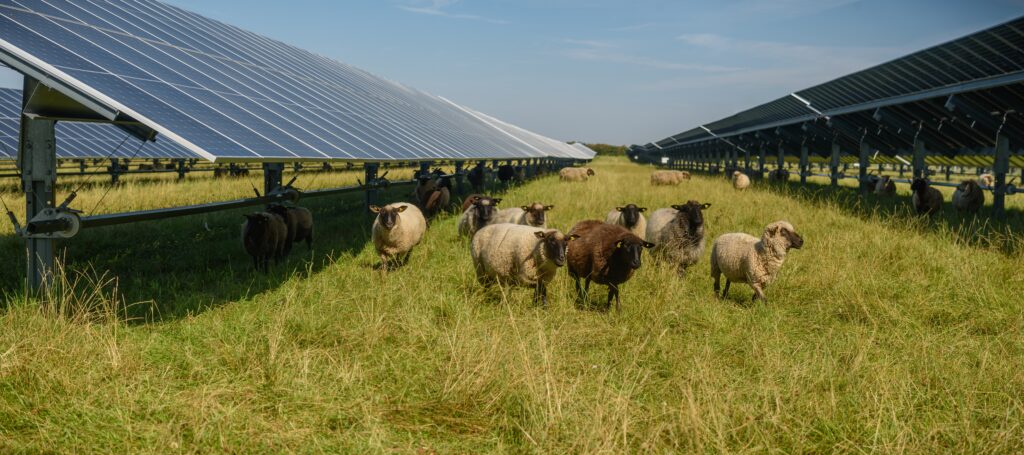
This article, however, focuses on PV systems on agricultural land, so called agrivoltaics. The term refers to the combined use of land for agriculture and electricity generation. PV systems are mounted at a certain height on agricultural land, and crop production or animal husbandry can happen underneath the elevated panels or in-between rows, for instance. Agrivoltaics can even enable triple land use: the simultaneous use of land for solar photovoltaic power generation and agriculture whilst incorporating water management solutions into the infrastructure. Integrating solar technology into agricultural activities enhances climate resilience by providing movable shade, reducing water consumption, improving soil health and protecting crops and livestock from extreme heat. For farmers, agrivoltaics can provide an additional source of income, as can be read in this blog post.
In the EU, agrivoltaics alone could overachieve the EU 2030 targets for PV by covering a mere 1% of the EU’s utilised agricultural area – that corresponds to 944 GW of installed capacity instead of the targeted 720 GW. Policymakers have also become aware of this potential, mirrored in the EU Farming Strategy ‘Vision for Agriculture and Food’. In 2025, the European Commission for the first time recognised solar energy as a ‘complementary tool for agriculture, providing energy security, decreasing GHG emissions, and – critically – offering farmers additional revenue streams’. It also marks the first time the European Commission has integrated photovoltaics into a broader strategy extending beyond electricity production. While there are currently around 200 projects underway, there could be significantly more in future.
Hence, the potential for agrivoltaics in the EU is huge. But how about other parts of the world – could political incentives and the transfer of know-how also contribute to the deployment of PV on agricultural land and the ensuing benefits elsewhere?
Whereas hot and dry regions with high solar radiation do not present an obstacle, but actually provide favourable conditions for PV, agricultural activities are too often challenging in these areas. This is true for many African countries, for instance. Africa has a vast potential for renewable energy generation, particularly in solar photovoltaics. However, solar energy still has a low market share in Africa’s overall energy mix, and around 600 million people still lack access to electricity on the continent. At the same time, the United Nations predict that by 2030, Africa will be the continent with the most people suffering from hunger. While it would be naive to assume that agrivoltaics can solve this unacceptable reality, PV on agricultural land is slowly gaining traction on the African continent. Could the technology alleviate the situation at least to some extent?
Protection against heat and water loss, and increase in crop yields
As mentioned earlier, agrivoltaics can allow for the cultivation of crops by protecting them from heat stress and water loss. The shading the PV panels provide improves the microclimate beneath the solar panels and lowers the temperature on the ground, boosting agricultural productivity. A project in Algeria, for instance, has shown that agrivoltaics can lead to considerably higher yields, as well as size of the crops. Additionally, regions that have become infertile or that face progressive soil degradation due to extreme heat and drought can be restored with the help of agrivoltaics, while the favourable growing conditions also allow for a wider variety of higher-value crops to be cultivated, all whilst enhancing food security. The shading from the PV panels also lowers water demand by reducing water loss through evaporation. Meanwhile, agrivoltaic systems also allow for rainwater harvesting – this is particularly beneficial in dry and hot regions, where access to water is already limited.
Local power generation and sustainability
Through agrivoltaics, renewable electricity is produced directly on farming sites, which is particularly valuable for rural areas with unstable or no power supply. The electricity that the PV modules generate not only provides access to clean energy for the farmers and their agricultural business, but also for the local population, which in turn would support SDG7 (affordable and clean energy for all). Agrivoltaics can even generate energy at lower cost than the energy supplied by the national grid, as has been shown in Tanzania and Kenya. In parallel, the greenhouse gas emissions of the farming unit can be reduced, if the electricity generated is used directly on site, hence enabling more environmentally friendly farming and contributing to climate change adaptation.
New sources of income and jobs
The dual use of land for food and power production can also lead to a double income for farmers. The increased variety of crops already mentioned, as well as a potential income from the panels (e.g. through feed-in tariffs for surplus energy), can boost and diversify farmer incomes. Simultaneously, the installation, maintenance and operation of the PV modules also create jobs – even in structurally weak regions or in disadvantaged rural areas.
Land use and land use conflicts
Across the African continent, land management issues remain a significant challenge, driven by rapid population growth, the climate crisis and weak governance structures, as well as infrastructure projects such as solar farms that oftentimes encroach on farmland. Moreover, the increasing electricity demand fuels conflicts over agricultural land and contributes to deforestation, threatening both ecosystems and agricultural productivity. Agrivoltaic systems could improve this situation to some extent, as they enable the efficient and combined use of land. Additionally, large parts of the African continent have huge solar resources. To name but two examples, South Africa, with over 80% of the land receiving extreme amounts of solar energy and nearly 80% dedicated to agriculture, offers untapped potential of dual land usage through agrivoltaics, and in East Africa, solar radiation is up to seven times greater than in Central Europe, which could turn the region into a major beneficiary of agrivoltaics.
Conclusion
Accordingly, the advantages of agrivoltaics are enormous on the African continent, and thanks to high solar radiation, they might even be greater than in Europe. Political incentives and funding programmes that support the development of agrivoltaics could be a major lever to realise the multiple benefits the technology has. While agrivoltaics is still in the early stages on the African continent, the transfer of know-how and policy programmes, such as the Water-Energy-Food-Ecosystems Nexus, an approach focusing on integrated policy solutions that align water, energy and agriculture for mutual benefit, have the capability to improve food and energy security, all whilst benefiting the climate and the local population.
The views and opinions in this article do not necessarily reflect those of the Heinrich-Böll-Stiftung European Union | Global Dialogue.