


Hydrogen was the future once. But while the UK was quick off the mark in investigating the potential of H2 for heating homes, much of the original plans have been abandoned in favour of solar, wind and electrification, writes Ros Taylor.
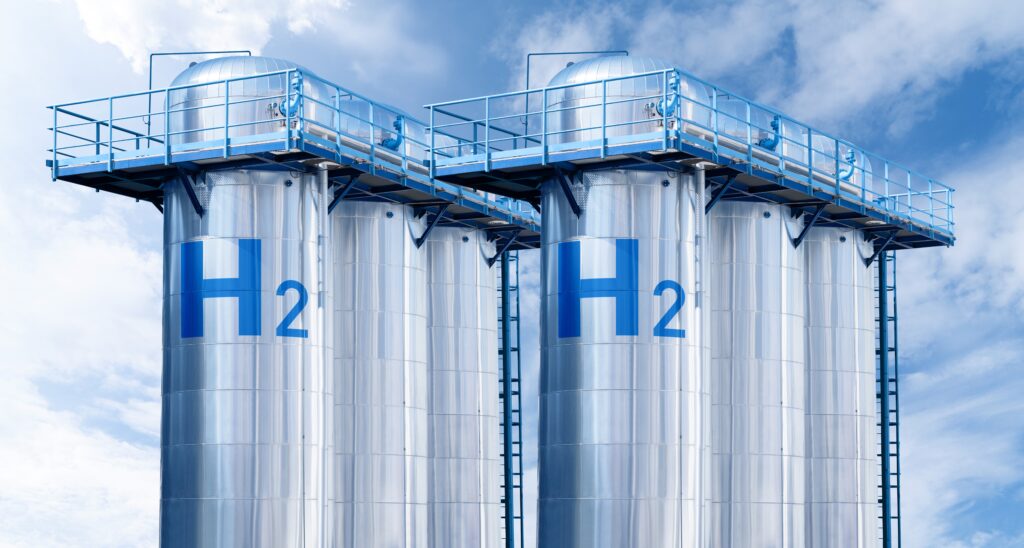
Credits Scharfsinn | Shutterstock, all rights reserved.
Methane gas heats more than three-quarters of British homes, making it one of the main sources of CO2 emissions. In 2017 the UK launched a programme called Hy4Heat to investigate whether it was feasible to move British households over from methane gas to hydrogen. There would be trials of home hydrogen boilers, and prototype hydrogen buses and trains. But nine years later, it is playing a far smaller role in decarbonisation than many people expected.
This year an updated Hydrogen Strategy is due to be published. It does envisage a role for hydrogen in a few sectors of industry, and possibly as aviation and shipping fuel. But as the recent Warm Homes Plan made clear, the focus is on ‘proven electric technologies’ because ‘hydrogen is not yet a proven technology for home heating’. The writing was already on the wall in 2023, when the Conservative government scrapped a planned hydrogen levy on energy bills. Nesta, the influential research foundation, came out against H2 for home heating at the same time, describing it as ‘inefficient’ and arguing that green hydrogen production would be limited and better used for industry.
Failed trials
One of the places chosen for home hydrogen trials was Fife in Scotland. The plan was to heat hundreds of households using H2 produced by an electrolysis plant, which would be powered by a nearby offshore wind turbine. But when I approached H100Fife for an interview, they declined, saying the project was in a ‘particularly critical phase’.
‘There have been a number of attempts to have village-scale trials of hydrogen boilers,’ says Stuart Dossett, a senior policy advisor at Green Alliance, but they have failed, ‘largely due to people who didn’t want to be guinea pigs. The best known one is Ellesmere Port in 2023. After pretty significant protests from the residents, it was scrapped. Ultimately people don’t want hydrogen boilers in their houses. They know there are risks.’ Some boilers currently on sale can adapt to a 20/80 per cent hydrogen/methane mix, but it looks unlikely they will ever have to use it.
In the last few years the potential for hydrogen leaks, even from a pipeline network, has become much more apparent. While it says the issue is still ‘poorly understood’, Green Alliance estimates the leakage rate would be between 0.1 to five percent, while the cost of building new pipelines would be around £1.5 million (€ 1.7 million) per km, or £340,000 (€ 393,000) per km to redevelop existing ones. Leakage is not just a problem because of wastage, but because it could contribute to global warming. ‘Hydrogen is an indirect greenhouse gas in that it interacts with levels of methane in the atmosphere,’ says Dossett. ‘Fundamentally, it’s a bad idea that fails on a number of tests – scale, leaks and the fact it is more expensive than heat pumps.’
The drive for electrification
For household heating and vehicles, the UK’s strategy is now clear. Electrification, more renewables and an upgraded National Grid are the key elements. For homes, subsidised heat pumps, batteries and solar panels will be integral, as well as heat networks in some places. The government recently announced that it would allow Britons to buy plug-in ‘balcony solar’ panels, which was previously banned. Insulation is also part of the Warm Homes Plan, though the UK’s old housing stock and a record of botched state-subsidised schemes makes this more challenging.
Ed Miliband, the energy and net zero secretary, hopes that Britain’s expertise in manufacturing gas boilers and air-conditioning systems can be transferred to heat pumps. Only a third of the heat pumps installed in Britain are made in the UK. Miliband wants that to rise to 70 percent.
However, some industry sectors are not going to be able to use electricity, and Dossett sees a role for hydrogen in those. Bringing down the cost of electricity – which is still unusually high in the UK – will be important in making green hydrogen schemes like the one planned for Fife more affordable. He also sees a role for hydrogen for very large aircraft and in shipping. ‘What’s key is its use is going to be by professionals’ – not householders – ‘and with minimal transportation’.
That means storing hydrogen in suitable locations near industrial clusters that need it. These will be salt caverns, which are fortunately plentiful in north west England, Humberside and the north east – close to many big industrial sites – and have been used to store hydrogen for more than half a century. Green Alliance considers them relatively leak-proof, with any hydrogen that does escape going into the surrounding geology rather than the atmosphere. It wants more research into hydrogen leakage during transportation in order to find out how to minimise it.
In April the government announced around £100 million (€ 116 million) in investment to develop green hydrogen manufacturing in south Yorkshire, largely for glass and steel factories. The UK is particularly keen to revitalise its steel industry, which has struggled to remain competitive with China.
Boosting heat pumps
The direction of travel is clear. But Britons are still sceptical about heat pumps, partly because of the complexity of installing them and partly because the high cost of electricity makes them relatively uneconomic. The UK has not yet even banned gas boilers in new-build homes, for fear of angering builders and the right-wing press. On the other hand, the government has so far resisted pressure – even from the Green Party – to cut gas bills due to the closure of the Strait of Hormuz. Dossett wants it to instead remove the levies on electricity, which he says could reduce bills by £80 (€93) a year.
Shortages of skilled professionals who can install heat pumps are another problem. ‘What the government can do there is provide longer-term certainty over schemes like the Boiler Upgrade Plan [a £7,500 (€8,680) subsidy to install a heat pump] – it’s 2029-30 that it’s currently due to run to. We need these schemes to have as long an end date as possible.’ Zero-percent loans would also tempt more people to install a pump. However, the next general election must be held by 2029, and if the anti-net zero party Reform wins, the scheme would certainly be scrapped.
Under the current government, hydrogen will have a role in decarbonising Britain, but the long job of rolling out heat pumps – for even under the most optimistic estimates, less than a million will be installed each year – is the priority.
The views and opinions in this article do not necessarily reflect those of the Heinrich-Böll-Stiftung European Union | Global Dialogue.