


Climate skeptics and fossil fuel lobbyists claim investment in renewables costs more than oil and gas. They are wrong. Investing in clean technology now ensures an infinite supply of free energy in the future and boosts jobs and growth in the EU. It also makes the devastating economic effects of a temperature rise of above two degrees less likely. Switching to renewables – and not trying to offset emissions through credits – should be Europe’s priority.
Fossil fuels are finite. Renewables are infinite. At a time when European governments are struggling to balance their budgets, falling back on oil and gas only makes it harder to limit temperature rises and pushes the savings from renewables further into the future.
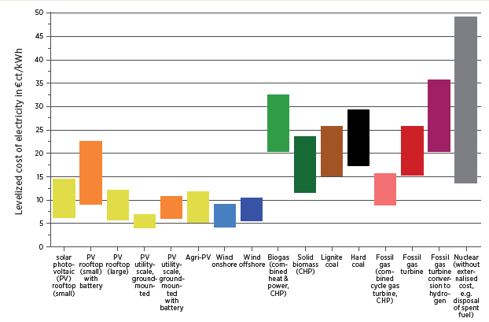
Levelized cost of electricity generation of renewable energy technologies and conventional power plants at locations in Germany in 2024
Source: Fraunhofer ISE (https://eu.boell.org/sites/default/files/2025-09/hbs-e-paper-climate-and-energy-final-150925.pdf)
The International Renewable Energy Agency has shown that newly installed renewables can often be cheaper than coal-fired electricity generation. Another model that takes into account the co-benefits of renewables – such as making extreme weather events less likely and boosting employment and productivity – put the cost-to-benefit ratio in the EU between 1.4 and 4 to 1.
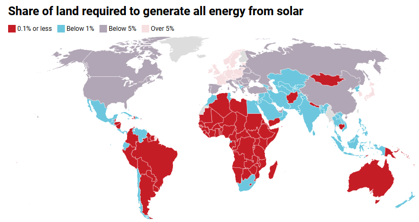
Renewable energy potential far exceeds demand. Carbon Tracker estimates that deploying current renewable technology in available locations would produce more than 100 times the energy the world currently uses. In much of the Global South, less than a thousandth of the land area would be needed to meet countries’ energy needs through solar power.
Share of land required to generate all energy from solar energy
Source: Carbon Tracker, based on Solargis, NREL, Jacobson, BP (https://carbontracker.org/reports/the-skys-the-limit-solar-wind)
In the EU, the European Environmental Bureau estimates that 2.2 percent of total land area would be required for solar and wind projects in order to supply so much clean energy that the EU could already achieve net zero by 2040.
Solar and wind are coming into their own
The price of solar and wind technology has fallen sharply in recent years, and it has dominated the growth in renewables. In the EU solar generation rose 22 percent between 2023 and 2024, with Spain, Greece and Hungary generating the biggest shares. With abundant solar power during the day, the challenge is now to deploy batteries and other clean flexibility options to bring down prices whenever the sun is not shining and the wind is not blowing.
Curtailment – the need to curb renewable electricity injection when the grid cannot absorb all the power being generated – is another challenge for the renewables industry. Batteries are part of the solution but better planning, grid infrastructure and management of demand will be crucial as more solar and wind projects go on stream. In turn, this will make energy infrastructure more resilient and flexible.
How the EU can support a successful transition
Accelerating the growth of cheap renewable electricity is at the core of the European Union’s strategy to boost competitiveness of its industries. If they quit fossil fuels and switch quickly to more efficient production processes powered by renewable electricity, they have a chance to secure a globally leading role, as highlighted in the Draghi report to the European Commission.
The European Commission has also identified several barriers to European renewable technology manufacturers becoming more competitive. European firms have higher manufacturing costs than competitors abroad and find it hard to compete with the cheap components that China produces. However, Europe has distinct strengths in cleantech manufacturing, especially in wind equipment, heat pumps, batteries and electrolysers. To maintain its lead, the EU may need to deploy strategic tariffs on Chinese imports.
Research and development are relatively strong in Europe, which holds a number of important patents, but investment and private finance remain relatively weak. Some of the key raw materials and components in clean technology come from non-EU countries, making supply chains less reliable.
The Commission’s aim is therefore to support cleantech manufacturing through its Clean Industrial Deal, stimulate European research and make the EU less reliant on imports of raw materials, for instance by increasing the share of recycled and domestically sourced materials.
For the same reason, it is important to avoid relying on international carbon credits to nominally achieving net zero. These let countries pay for emissions to be reduced outside the EU to offset continued emissions at home. As well as allowing industry to avoid decarbonising, some of these schemes have been of dubious quality. The money would be better spent investing in EU cleantech that creates jobs and growth.