


Europe has made good progress in cutting emissions and its fuel consumption, but in the last few years geopolitical shocks, rising energy prices and a rise in support for far-right parties are threatening the shift to renewables. But now is not the time to halt the energy transition. Europe bears special responsibility for global warming and its citizens are already feeling its impact.
Surface air temperature anomalies in 2024
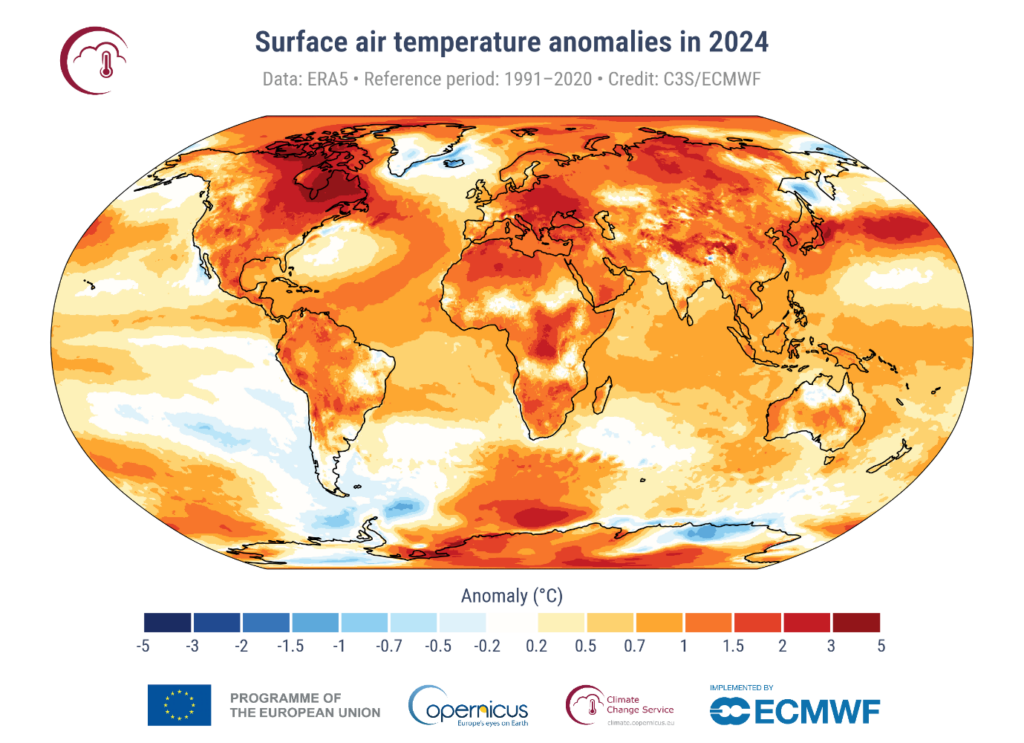
Europeans are already feeling the impact of the climate crisis. Source: ECMWF, The Copernicus Project ( https://climate.copernicus.eu/copernicus-2024-first-year-exceed-15degc-above-pre-industrial-level )
Since the Paris Agreement was signed more than a decade ago, the reality of climate change has become apparent to Europeans. Unprecedented heatwaves, severe flooding and shrinking glaciers and snow cover in the Alps can leave people in no doubt that temperatures are rising. Thirty-eight percent say they feel personally exposed to global heating, according to a Eurobarometer survey in 2025. To give just one example, Spain – where temperatures exceeded 45 degrees during the summer of 2025 and 3,800 people died of heat-related conditions – has announced plans to open a network of climate shelters. A big majority of Europeans (85 percent) say that tackling the crisis must be a priority, with an even higher percentage calling for more renewable energy and energy efficiency.
The EU has committed to climate neutrality by 2050. Its efforts to phase out fossil fuels and switch to renewables have made considerable progress. By 2023 renewable energy accounted for a quarter of gross final energy consumption, up from 8 percent in 2005. On this metric, the EU is well ahead of the US and still outperforms China, though it lags behind the UK, which has also managed to almost completely phase out coal. Notably, renewables accounted for almost half of the EU’s electricity production in 2024. Solar and wind power have driven the transformation.
New setbacks
However, the EU’s commitment to the energy transition is stalling. While the switch to renewable technologies is well underway and the manufacturing base for clean tech is growing, progress on other measures to decarbonise the economy has been far slower. The task of reducing dependence on fossil fuels and ensuring a just transition is undermined by too many subsidies and tax breaks for carbon-heavy industries and agriculture.
The Trump administration questions whether humans are responsible for climate change and is reversing many of Joe Biden’s decarbonisation policies, leading to deep pessimism about the ability of the EU to stop global temperatures rising above 1.5 degrees. American gas and crude oil production have risen steadily during the 2020s, as has Chinese coal mining. Consequently, the International Energy Agency has revised down its projections for the growth in global renewables capacity. China’s enormous investments in renewables have driven down their cost, but this has led to fears that EU clean tech firms will be unable to compete.
While the Eurobarometer survey shows that Europeans overwhelmingly want to achieve energy independence and phase out fossil fuels, the rising cost of energy since the price shock caused by Russia’s invasion of Ukraine has shifted the priorities of national governments – even though Germany, for example, has managed to drastically cut its imports of natural gas and reduce demand for energy since the beginning of the decade. Some are now focusing on cutting energy prices rather than investing in clean energy.
At a European level, the influence of climate-sceptic far-right parties in the European Parliament and at a national level is making the EU more averse to passing climate legislation. With bad-faith actors and vested interests promoting disinformation, it has proved difficult to convince the public that decarbonisation can represent a US-style ‘New Deal’, where new jobs and cheaper energy spur growth rather than inhibit it. The 2025 power cut in Spain and Portugal has been used by sceptics to argue that the shift to renewables has been too rapid, even though there is no evidence it was caused by switching to solar and wind.
Europe needs to move faster, not slow down
As a result, it looks less likely that the EU can meet the twin milestones that were agreed at COP28 of tripling renewable power capacity and doubling the rate of improvement of energy efficiency. The International Renewable Energy Agency has identified obstacles to decarbonising domestic heating (the low take-up of heat pumps) and scaling up renewables other than solar.
Electricity generation in the EU
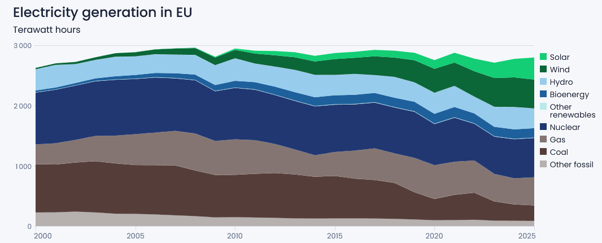
Source: Ember, Eurostat, IRENA, ENTSO-E (https://ember-energy.org/data/electricity-data-explorer/?tab=main&chart=trend&entity=EU)
The EU’s ‘Fit for 55’ goal of reducing emissions by 55 percent by 2030 (compared to those in 1990) is not ambitious enough – and the measures it currently plans to take would only cut emissions by 48 percent. Reaching net zero by 2040, as the UN secretary general has advocated, is feasible if governments stop subsidising fossil fuels and the European Commission implements an action plan to encourage people to change their diets, household heating and transport.
Europe was the first continent to industrialise. It therefore bears a special responsibility for tackling the rising temperatures caused by burning fossil fuels. All countries can reduce their emissions, but Europe’s manufacturing base and ability to muster co-ordinated support and progress through the EU put it in a strong position to cut emissions further and faster.