


Since the invasion of Ukraine, the EU has successfully pivoted away from importing Russian fossil fuels. But this has made it more dependent on authoritarian regimes and an increasingly unfriendly US. Wars in the Middle East have put Europeans at the mercy of world events beyond their control. Europe urgently needs to switch to domestic renewable sources of energy so that it no longer relies on oil and gas.
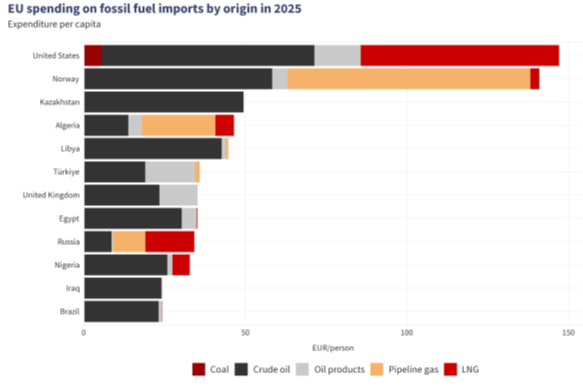
EU spending on fossil fuel imports by origin in 2025
Source: CREA, based on ENTSOG, Kpler, Eurostat, UN COMTRADE (https://energyandcleanair.org/wp/wp-content/uploads/2026/01/CREA_EU-CO2-emissions-fossil-fuel-imports_2025.pdf)
Before Russia invaded Ukraine in 2022, it was supplying more than 40 percent of the European Union’s fossil gas. Revenue from these sales funded Vladimir Putin’s authoritarian regime and his war on Ukraine. Thanks to a determined effort to import gas from other countries, Russian gas imports fell and accounted for around 11 percent of the mix in 2024. About a third of the EU’s consumption now comes from its neighbour Norway, with the US and Algeria supplying much of the rest.
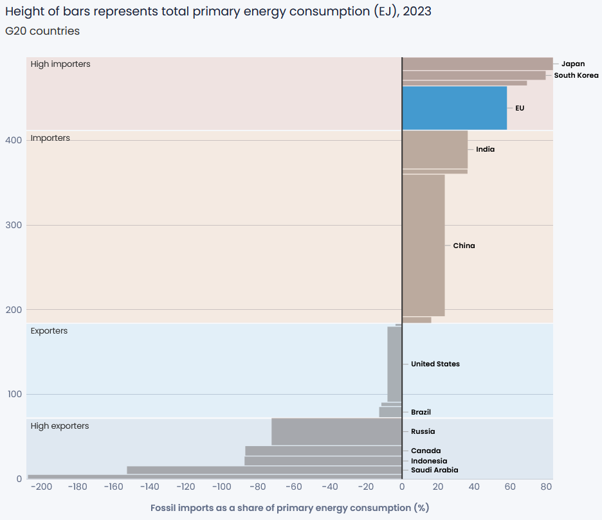
The EU is more reliant on fossil imports than other major economies
Source: Ember, based on based on IEA World Energy Balances (https://ember-energy.org/latest-insights/shockproof-how-electrification-can-strengthen-eu-energy-security/europe-is-highly-vulnerable-due-to-reliance-on-fos)
The rapid pivot away from dependency on Russia is testament to the EU’s resilience and it has avoided a full-blown energy crisis. However, the Union is still the world’s biggest importer of liquid natural gas (LNG) and remains heavily dependent on it. Thirty percent of households still rely on gas for heating, and it is used extensively in industry and electricity generation. More than a tenth of Europeans could not afford to properly heat their homes in 2025, with a similar proportion in the UK. But colder regions of the EU suffer disproportionately more. This is not merely unjust but drives resentment and political instability. Rising energy prices have fed inflation in many European countries and increased support for populist parties, some of which have close links to Russia.
At the end of 2025 the European Parliament approved a plan to phase out Russian gas imports completely. It has faced opposition from Hungary and Slovakia, which continue to get the vast majority of their gas from Russia.
Europeans must still go cap in hand to unfriendly regimes
But relying so heavily on LNG imports from elsewhere still weakens the EU, particularly when the US is no longer a reliable ally and has withdrawn military funding for Ukraine. It makes the bloc far more vulnerable to geopolitical shocks, forcing it to pay whatever prices suppliers demand to keep the lights on.
The EU also imports large amounts of oil. Before 2022, Russia supplied more than a quarter of it. That figure is now 3 percent, with Hungary and Slovakia accounting for the vast majority of that. In August 2025 alone, the EU spent 1.15bn euros on fossil fuels from Russia, according to the Centre for Research on Energy and Clean Air (CREA). In 2024, this was more than the bloc sent to Ukraine in financial aid, according to CREA.
Relying on authoritarian and sometimes unstable regimes to supply oil and gas is not a viable long-term strategy for the EU. Kazakhstan, Libya, Saudi Arabia and an increasingly hostile US supplied around 45 percent of its petroleum oil in the second quarter of 2025. When America and Israel attacked Iran in 2026, the disruption to energy supplies drove up oil prices, forcing Europe to release its reserves. The US is well aware that its ability to supply EU energy needs is a powerful bargaining chip in trade and security negotiations, including over the war in Ukraine. Indeed, Commission president Ursula von der Leyen has pledged to buy $750bn of US energy by 2028 to avoid even more punitive tariffs, a quantity the US may not even be able to supply, and the EU cannot afford. Such deals risk locking in dependence on fossil fuel imports, expanding and embedding the infrastructure they rely on.
Energy security protects Europeans against price shocks
Energy independence for the EU relies on a triple-pronged strategy: cutting energy use through efficiency, shifting to renewable sources of energy and ensuring that industry, domestic heating and transport run on renewable electricity rather than fossil fuels. Globally, three-quarters of fossil fuel imports are for sectors which can be electrified.
Energy independence and security make a powerful argument for renewables. Even people who are unconvinced about the climate crisis can be swayed by the need to stop funding Russia’s imperialist ambitions, which may not stop at Ukraine. Should Putin launch an attack on an EU member, any dependency on Russian energy could prove catastrophic. Several EU countries, notably Denmark, Lithuania and Portugal, now generate around 80 percent of their electricity from renewables, making them more resilient to price shocks.
Dependency on Russia, authoritarian regimes and the US for energy undermines the EU’s sovereignty, democratic values and commitment to peace on the continent. Now is the time to definitively move away from fossil fuels and ensure Europe can supply its own energy needs.