


The ’battery revolution’ is transforming the debate over whether renewables can power whole economies. New battery storage options can be the backbone of a complex, decentralized, volatile grid. Paul Hockenos reports.
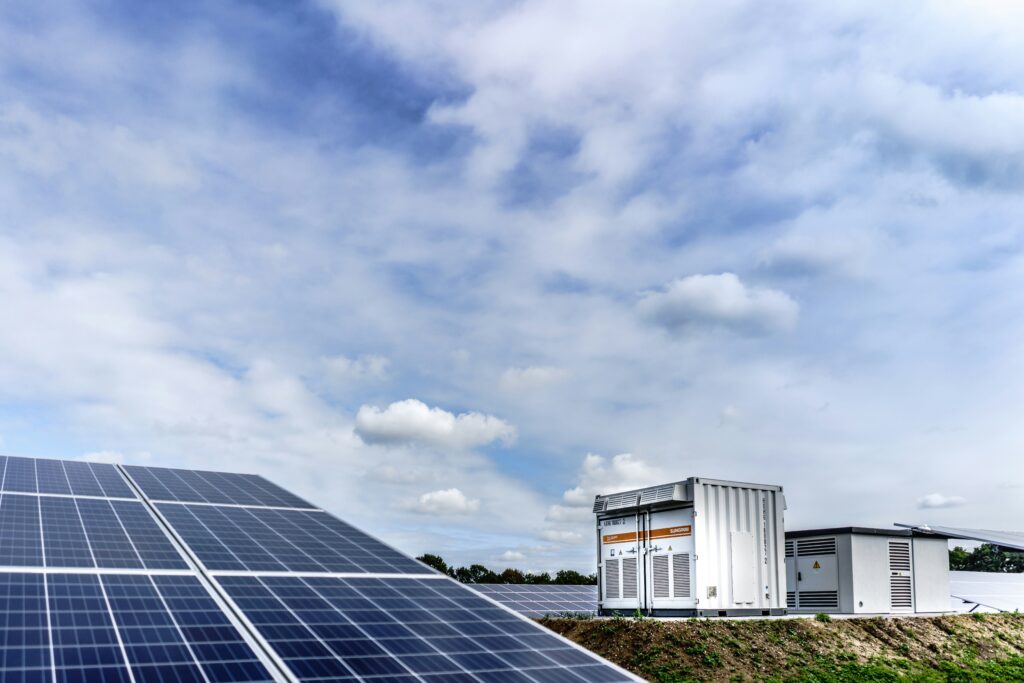
On the tiny neck of land connecting northernmost Germany to Denmark lies Germany’s largest battery, the pride of a German-Norwegian firm. Since last year, the three-acre site, surrounded by farmland, has hosted 64 gleaming white industrial containers arranged in symmetrical rows, housing over 200,000 South Korean–manufactured lithium-ion batteries. This volume can supply around 170,000 households with renewable electricity for two hours – valuable in a region that produces and relies heavily on wind power.
But battery storage is expanding so fast in Germany, and globally, that this facility will soon be dwarfed. One project in eastern Germany will soon keep the lights on in 1.6 million households for four hours. Even that behemoth – part of a ’gigawatt factory’ combining solar power, wind power, battery storage and hydrogen-capable gas plants – won’t be Europe’s record holder for long, as battery storage is expected to grow six-fold by 2030. Part of that growth, thanks to EU legislation, will come not from monster-size batteries but from models small enough to fit under a car hood or in a basement.
‘The quest for reliable, cost-effective electricity storage has long been seen as a holy grail for the power sector,’ says Toby Couture of E3 Analytics. ’Now, after decades of technological advances, accelerated by the economies of scale from mobile phones, we essentially have it. And it’s changing everything.’
Experts describe a ’battery revolution’ breaking over global markets, as utility-scale storage costs have collapsed while hardware capacity has surged. This shift is transforming the debate over whether renewables can power whole economies. ’Solar and wind energy, paired with battery storage, are reliable and already deliver cost-effective, round-the-clock electricity,’ concludes a new report from the International Renewable Energy Agency (IRENA).
’Over the last 25 years, we added renewables, renewables and more renewables that introduced incredible volatility, but we had few ways of balancing it out,’ says Eva Zimmermann of Aurora Energy Research. ’Our energy systems were still stuck in the age of fossil fuels.’
Until recently, critics could point to the intermittency of sun and wind as reason for doubt, warning of blackouts on overcast, windless days. Storage options – pumped hydro, compressed air, flywheels, green hydrogen, batteries and so on – were too costly or impractical. One of the transition’s central challenges is ensuring clean electricity is available whenever and wherever needed, not only when conditions are favourable.
This is why storage was long considered the ‘missing link’ for a renewables-powered world. Now it’s called ’the great enabler’.
’The long-standing argument that renewables lack reliability no longer holds,’ says IRENA Director-General Francesco La Camera.
’The new battery storage options can be the backbone of a more complex, more decentralized, more volatile grid,’ says Kai-Philipp Kairies, a battery expert and energy company founder. ’Every day our grids are getting more complex – for example with data centres. Batteries are keeping the lights on.’
Falling costs, rising stakes
Innovations in lithium-ion chemistry have driven battery storage prices down by as much as 93 per cent since 2010, and the decline isn’t over. The broader ‘electrification of everything’ – the shift from fossil fuel technologies to electric alternatives powered by renewables – has pushed prices down further.
Just as important, experts say, is the maturing of energy storage markets, once a niche component of power systems and now central to the global energy transition. In most places, pumped hydroelectric storage was the technology of choice, converting electricity into kinetic energy by pumping water uphill and releasing it on demand.
Zimmermann says EU legislation liberalizing energy markets arrived ’at just the right time’ – as Russia’s invasion of Ukraine sparked an energy crisis demanding more renewables online, fast. ’These new liberalizations enabled battery storage to enter the market and offer the grids exactly what they needed.’
A renewables-based system doesn’t just need more storage capacity – it needs more providers that can respond within seconds or minutes. This extreme volatility has driven the rise of faster balancing markets, such as ancillary services and grid stabilization measures like voltage control – matching supply and demand in real time in ways unimaginable five years ago.
Kairies, owner of ACCURE Battery Intelligence, which offers ancillary services, explains: ‘Grid operators pay generators to hold back energy and push it into the grid on demand – that’s been done with gas and coal plants for decades. Batteries do it better. They’re more dynamic, controllable at finer granularity, and their cost is a fraction of legacy players like gas, coal, and pumped hydro.’
’Battery storage can significantly reduce the need for expensive backup gas power plants,’ adds Carsten Körnig of BSW Solar, Germany’s solar energy association. ‘They can be built more quickly, produce no direct CO₂ emissions and reduce system costs by integrating renewable energy and alleviating grid congestion.’
Room for small players
Utility-scale battery farms will do the heavy lifting in balancing markets, but there’s room for smaller players too. EU legislation opened the market to ‘prosumers’, much as it did for household renewable energy producers decades ago. Germany leads Europe, accounting for roughly 70 per cent of residential storage capacity, driven by payments for feeding stored energy into the grid and subsidies covering up to 30 per cent of storage costs. The US is catching up, especially in California, Texas and Hawaii, where a 30 per cent federal tax credit applies to small-scale residential storage. Homeowners can earn hundreds to over $10,000 annually selling storage capacity to virtual power plants – companies that aggregate this flexibility to provide balancing services to grid operators.
In the UK, consumers are responding to the energy crisis by investing in batteries and other green solutions. ’For the right home, home batteries can cut bills, increase flexibility and make everyday energy use smarter and more resilient,’ says British energy expert Tom Pakenham.
Germany’s energy transition remains a work in progress. It aims to generate 80 per cent of its electricity from renewables by decade’s end, and the more wind and solar in the grid, the more fast-responding flexibility it needs. One German research institute estimates storage demand of 100 to 170 GWh by 2030 – against a current capacity of just 27 GWh.
IRENA’s report also urges caution. Lithium-ion systems provide only short-duration storage, it notes; higher renewable shares will require long-duration solutions, such as sodium-ion batteries, solid-state systems, iron-air storage and green hydrogen. The rollout also demands vast volumes of critical minerals, whose extraction carries well-known environmental and geopolitical risks.
Battery advances will drive another nail into the coffin of fossil fuels and nuclear power – but buildout must cover both existing renewables and those now entering the system. ’We’re still playing catch-up as the target moves ahead,’ says Zimmermann. In Europe, the first quarter of 2026 saw twice as many negative-price days as the same period in 2025. Catching up with its own renewables expansion by 2030 will take some doing.
The views and opinions in this article do not necessarily reflect those of the Heinrich-Böll-Stiftung European Union | Global Dialogue.