


Fossil fuels and nuclear power have put power and money into the hands of a few big corporations and foreign regimes. Renewables are an opportunity to give individuals and communities more say in their energy supply and who profits from it. They open up a range of new jobs and save money.
Citizens fair participation in the EU energy transition
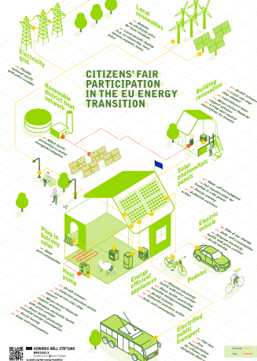
Source: Heinrich-Böll-Stiftung EU (https://eu.boell.org/sites/default/files/2025-11/final_infographic_citizens_eu_energy_transition.pdf)
The old model of piping gas into people’s homes and leaving them at the mercy of fluctuating fuel prices has disempowered Europeans. It means they have no control over where their energy comes from or how it is generated. They often rely on oil and gas from authoritarian and violent regimes that they would never choose to support financially, and suffer energy price spikes when war breaks out or energy exporters decide to keep prices high. Nor have they had much ability to decide how their energy supply is organised. In some countries, electricity distribution is controlled by a single national provider that has little incentive to devolve any of its decisions.
Advocates of nuclear power argue that it offers the opportunity to cut carbon emissions and is a reliable source of electricity. But as in the case of fossil fuels, the vast investment required to build nuclear power stations – usually in the form of loans – often leads to dependency on foreign governments, and ensures benefits remain in the hands of a few big companies. When accidents happen, as at Chernobyl and Fukushima, the results may be catastrophic.
Devolving power and creating new jobs
By contrast, renewable technologies can be embedded in communities and give local people control over generation. Millions of Europeans directly use renewable energy, in particular solar electricity from their rooftop, to save money. In Germany in 2019, private individuals and energy communities owned more than 30 percent of all renewable energy installed capacity in the country. The boom in balcony solar has cut a typical flat’s electricity bill by a third. France has encouraged people to buy equity in local energy projects which are now yielding returns. Switching to local renewable energy sources does not require capital-intensive global corporate players. Small and medium-sized enterprises, farmers, municipal utilities and local banks are main drivers of the local energy transition. The decentralised character of renewable energy installations leads to a higher local value added. Benefits tend to remain in the region. Rural and peripheral regions can catch up by becoming net renewable energy exporters to neighbouring urban and industrial regions.
Number of jobs created per US dollar invested
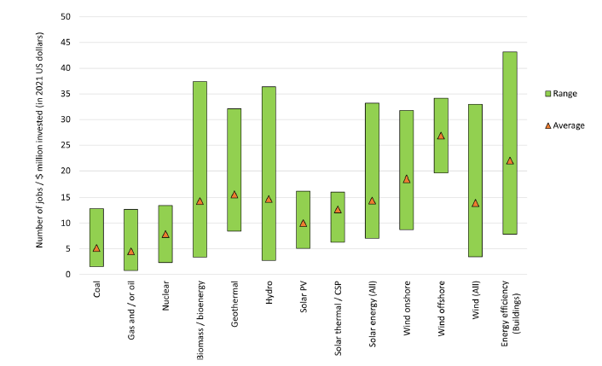
Source: Hanna, R., Heptonstall, P. & Gross, R. Job creation in a low carbon transition to renewables and energy efficiency: a review of international evidence. Sustain Sci 19, 125–150 (2024) (https://doi.org/10.1007/s11625-023-01440-y)
Renewables create new jobs at all stages of the value chain, from local planning to manufacturing components and managing rollouts, maintenance and demand. Using renewable energy sources on average creates more employment than extracting and burning fossil fuels or running a nuclear reactor. Renewable industries also offer more job opportunities to women than their traditional counterparts do. Jobs in fossil fuel industries are dominated by men, who hold 78 percent of roles. Women hold nearly a third of the jobs in renewables, and proportionately more in solar. Only 16 percent of senior management roles in oil and gas are filled by women: in solar and wind, the figure is a quarter.
Rather than being passive consumers of energy, households that generate their own energy can decide how best to use it. For instance, at some times of the day solar panels will produce more electricity than a household can use. Rather than selling the excess back to the grid, which is unprofitable during peak generating periods, households can sell electricity to other families or even subsidise relatives who cannot install solar themselves. This energy sharing model is also an efficient way of supplying cheap renewable electricity in multi-storey dwellings. More and more social housing companies in the EU invest in solar self-generation to protect their tenants against energy poverty. A community that shares the energy from a wind turbine can all benefit from lower bills.
Similarly, using locally generated electricity to plug in electric vehicles at peak generation times saves money for people who need their own transport and who would otherwise have paid for petrol. These vehicles can then be booked and paid for on a per-kilometre basis, enabling people who only need a car occasionally to avoid buying or leasing one.
A fairer model
Schemes like these are a fairer way of distributing the benefits of renewables. They avoid putting the onus on individuals to pay for cleantech like heat pumps upfront. The high initial investment pays off but often only the better-off can afford it and take advantage of the state subsidies available. While the promise of community energy is great, governments are still working out how to support it in the right way. In Britain, for example, better-off rural areas have been more willing to take on the bureaucracy involved in setting up a project and attracting investment from the private and public sector.
At the most basic level, the cheaper energy that renewables provide gives people more disposable income to spend locally, rather than propping up petrostates. It reduces spikes in inflation and means governments no longer have to subsidise fuel bills to keep their citizens warm in winter, as many still do. This eases the cost-of-living pressures that are driving frustration and polarisation among Europeans.