


In the quiet scrubland of Waynesboro, Georgia, two enormous concrete domes rise from the landscape. Vogtle Units 3 and 4, the first new nuclear reactors built in the US in more than 30 years, were once touted as the rebirth of US American nuclear ambition. Instead, they have become a monument to mismanagement and cost overruns – conclusive evidence that nuclear power is a nonstarter. Paul Hockenos reports.
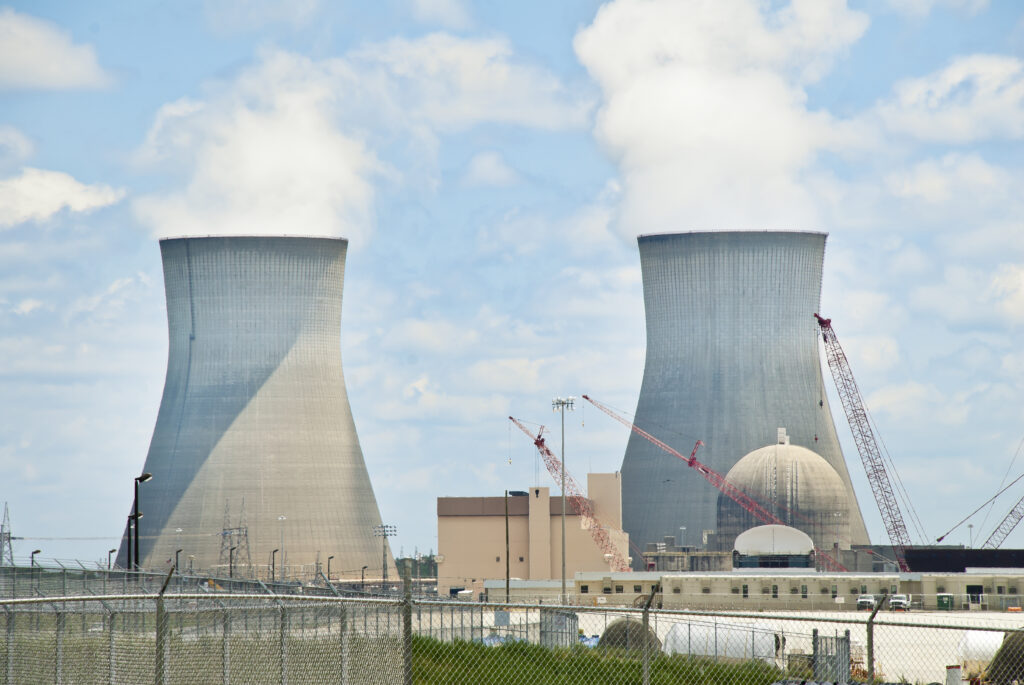
Credits Denton Rumsey | Shutterstock, all rights reserved.
The story of Vogtle is a cautionary tale illustrating that nuclear power cannot be delivered cheaply, quickly and reliably in democratic societies with up-to-scratch regulatory systems. Time and again, from South Korea’s reactors at Shin Kori and Shin Wolsong to Finland’s Olkiluoto-3 and France’s Flamanville EPR, on-the-ground experience has proven otherwise. Vogtle belongs squarely in that lineage, but with a uniquely US American twist: the financial burden has been shifted almost entirely onto the backs of ordinary consumers.
A promise of renaissance
The Georgia Public Service Commission approved the project in 2009: two Westinghouse AP1000 reactors, at a cost of USD 14 billion in total, online by 2016 and 2017. Clean, reliable emissions-free baseload power – an answer to climate change that didn’t depend on fickle solar output or fossil gas.
But by the time the reactors finally limped into commercial service – Unit 3 in July 2023 and Unit 4 in April 2024 – the price tag had swollen to more than USD 36.8 billion, cementing Vogtle’s place as the most expensive power plant ever built in human history. Not even the notorious cost spirals of European nuclear megaprojects come close: Finland’s Olkiluoto-3 ballooned to €11 billion, meaning that Vogtle surpassed that threefold.
This is not simply a cost overrun but rather a systemic indictment of the nuclear construction model: slow, labour intensive, technologically rigid and utterly incompatible with modern energy economics.
Ratepayers foot the bill
The primary victims of this financial misadventure are Georgia Power’s 2.7 million customers, many of whom were compelled to subsidize the reactors long before they produced a single kilowatt-hour of electricity. Thanks to a legislative instrument called Construction Work in Progress, households were effectively forced to act as involuntary venture capitalists, paying roughly USD 1,000 per household in advance charges.
Georgia Power collected USD 17 billion in profits during the construction period, while shareholder losses were capped at around USD 3 billion. Ratepayers, meanwhile, will carry billions in future costs for decades. This is why they pay the highest power bills in the US.
Now that the reactors are online, the financial pressure has only intensified. Residential electricity rates have jumped roughly 24 per cent, with new hikes expected. Analysts estimate that electricity from the new units is five times more expensive than equivalent capacity from solar plus battery storage – an astonishing figure in a region with some of the best solar potential in the US.
A cascade of failures
To understand how Vogtle spiralled into a USD-22-billion cost-overrun fiasco, one must examine the full sequence of missteps – a textbook example of how nuclear megaprojects fail globally.
One of the most consequential errors occurred before construction even began. Westinghouse launched the project without a completed reactor design, a mistake so fundamental it borders on negligence. This error echoed Europe’s nuclear struggles at Olkiluoto and Flamanville, where partially completed designs led to cascading construction problems. In 2017, Westinghouse – burdened by the Vogtle AP1000 debacle – filed for bankruptcy.
That collapse forced Vogtle’s owners to take over the direct management of the project, a role for which they were ill-prepared. What followed was a sprawling mess of renegotiated contracts and design revisions. Independent monitors documented that Georgia Power repeatedly provided ‘materially inaccurate cost estimates’, undermining any possibility of regulatory oversight. Nevertheless, the Public Service Commission allowed construction to continue and rejected its own staff’s recommendations to cancel the project – decisions that are costing Georgians billions.
Then came the workforce crisis. Because the US had not built a nuclear reactor in decades, the skilled labour pipeline had atrophied. Vogtle thus became a crash-course training ground for thousands of inexperienced workers. Attrition among electricians reached 50 per cent. Component failure rates hit 80 per cent at times, necessitating extensive and costly do-overs.
The result is damning: a project lost in its own complexity, burdened by the weight of an entire industry that had forgotten how to build what it claimed to champion.
What Georgia could have had instead
What makes Vogtle’s story especially tragic is not merely what Georgians must now pay, but what they could have had. The nearly USD 37 billion could have financed a diversified portfolio of renewable energy: solar farms, battery storage and energy efficiency upgrades that would have delivered more capacity at lower cost and in far less time.
Renewable energy has evolved into something antithetical to nuclear power: decentralized, modular and increasingly affordable systems that can be scaled rapidly without the all-or-nothing risks of nuclear megaprojects. Just about everywhere in the world, solar and wind are being installed in record volumes precisely because they are nimble, predictable and financially transparent. Nuclear, by contrast, requires vast upfront capital, long construction timelines and political intervention to remain viable.
Georgia, with its abundant sunshine and growing distributed-energy ecosystem, could have led the US South into a new era of affordable clean power. Instead, its utility regulators locked the state into a nuclear future that its customers regret.
The lessons of Vogtle
Vogtle Units 3 and 4 were marketed as a blueprint for America’s nuclear future. In reality, they have demonstrated that the economics of traditional nuclear construction in the US are fundamentally broken. Not broken at the margins, but broken at the core – structurally, financially and technologically.
This project, like so many others, depended not on engineering brilliance but on regulatory leniency, optimistic accounting and public subsidy. Its failures are not the product of unfortunate circumstance, but of a model that no longer fits the realities of modern energy infrastructure.
The legacy of Vogtle is thus a warning to policymakers, regulators and utility executives: nuclear power, in its large-scale conventional form, cannot compete in the contemporary energy economy – not on cost, not on time and not without burdening the very people it claims to serve.
For ratepayers, Vogtle is a generational misfortune. For the nuclear industry, it is another nail in the coffin of the ‘renaissance’ that never arrives. And for everyone concerned about climate change, it is a reminder that the clean energy transition cannot afford fantasies, wishful thinking or vanity megaprojects.
One would think the lessons of Vogtle incontrovertible. But in May 2024, the Biden administration’s energy secretary Jennifer Granholm attended a ribbon-cutting ceremony for the recently connected units. Her conclusions were very different: she predicted that 198 more such large-scale reactors will join the Vogtle units, which she considered a success story.
What Georgia has built is not a triumph of American ingenuity but rather a fraud that should speak the final word on nuclear power in the US.
The views and opinions in this article do not necessarily reflect those of the Heinrich-Böll-Stiftung European Union | Global Dialogue.