










































































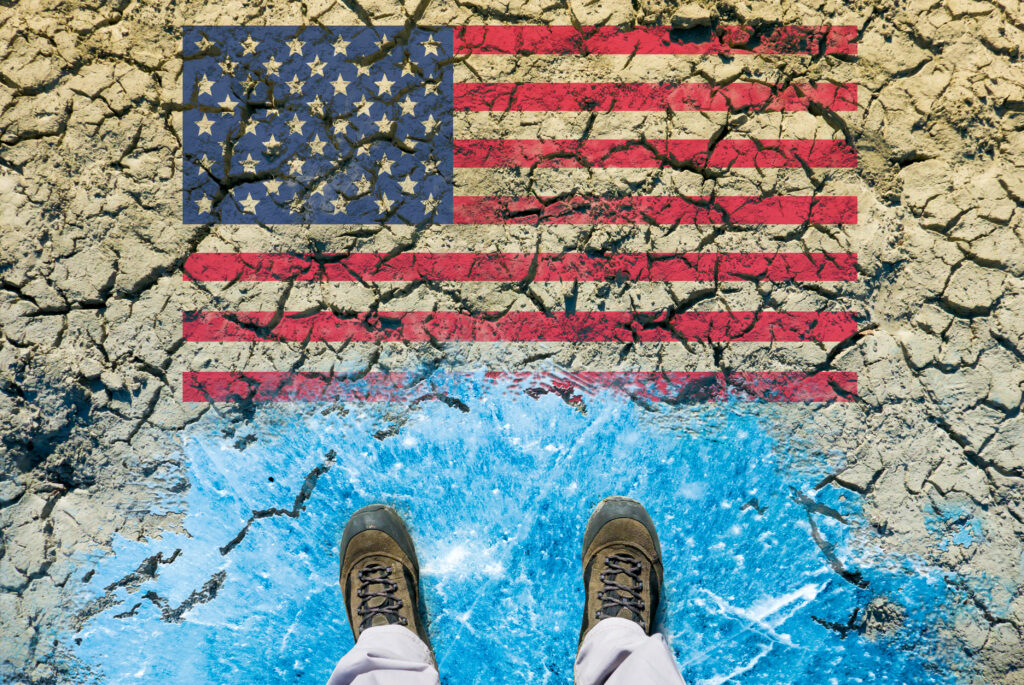
The Trump government has taken a battleaxe to US climate programmes and yanked the country out of international climate diplomacy. By dismantling agencies and budgets, it undermines the US’s capacity to anticipate, mitigate and adapt to the climate crisis. There is no way to put a positive spin on it. A future Democratic administration will need consecutive terms in office to reverse the carnage. Paul Hockenos reports.
Credits: DarwelShots | Shutterstock, All rights reserved.
In less than 100 days, the cuts and closures reversed just about all of the Biden administration climate and renewable energy measures, as well as much of the environmental bulwark established by previous Republican and Democratic governments. This is a structural shift away from federal leadership in renewables buildout, climate science, adaptation, conservation, and regulation. The blitzkrieg heaps doubt on hard climate science and bets everything on the expansion of fossil fuel and nuclear energy as the way forward. They, not renewables, are boosted with federal lands and hundreds of millions in subsidies.
‘Through executive orders, agency memos and other policy moves,’ reports The Guardian, ‘the Trump administration has deleted a swath of Joe Biden-era green policies, frozen climate spending, removed the US from the Paris climate accords, and set about rewriting pollution standards for cars, trucks, and power plants.’
In the administration’s first hundred days, it took 145 actions against environmental laws. ‘The deregulatory ambition of this administration is mind-blowing. This is the most anti-environmental administration that our country and perhaps the world has ever seen,’ said longtime environmentalist and author Bill McKibben. The Trump administration’s budget law – the so-called ‘Big Beautiful Bill’ – is, according to a Heinrich Böll Stiftung report, a back door to implementing major portions of the MAGA agenda. It could become one of the most destructive, anti-climate, anti-poor and anti-working-class pieces of legislation in US history, it concludes.
Renewables
The solar, wind and grid-integration programmes that the Biden administration put into law are being zeroed out or dramatically reduced. The current budget eliminates tax incentives for solar, wind, battery storage and other clean energy technologies. These incentives, created under Biden’s Inflation Reduction Act (IRA), were a driving force behind the rapid expansion of the clean tech sector in the US – in Republican states as well as Democratic. ‘The bill repeals several landmark consumer incentives from the IRA, such as the 7,500 US dollar federal electric vehicle tax credit, and subsidies for residential solar and heat pump installation,’ according to the Böll report.
Climate science
At the United Nations General Assembly in September 2025, Trump blasted climate science as the ‘greatest con job ever perpetrated on the world’ and claimed that ‘stupid people’ forged the scientific consensus on global warming. As it trashes climate science as a ‘hoax’, the government is slashing a third of the budget of the National Oceanic and Atmospheric Administration (NOAA), the scientific and regulatory agency charged with forecasting weather, and monitoring oceanic and atmospheric conditions. Climate research programmes are being terminated. Although the administration wants to eliminate NOAA’s Office of Oceanic and Atmospheric Research, the bill is currently in Congress, where it is facing fightback from both parties.
Moreover, the Environmental Protection Agency’s Greenhouse Gas Reporting Programme, ‘the country’s most comprehensive way to track the heat-trapping greenhouse gases that are dangerously warming the planet’ (according to the New York Times) has also been terminated.
The Trump administration has also purged government websites. It has removed the term ‘climate change’ and deleted webpages about climate impacts. Mandated scientific reports have been pulled from publication.
Climate adaptation
And then there’s the elimination or scaling back of programmes that help communities prepare and respond to climate-related disasters. Programmes that help coastal communities adapt to rising seas and increased storms are on the chopping block, as are the Federal Emergency Management Agency’s (FEMA) programmes for disaster preparedness and recovery, and the construction of resilient infrastructure, such as storm-proofing of schools, hospitals and police stations. The Office of Community Planning and Development, which handles disaster recovery, is losing over three-quarters of its staff. Moreover, cuts to water infrastructure and clean water revolving funds reduce the capacity for municipalities to prepare for and respond to climate‐driven changes, such as more extreme precipitation and flooding.
Regulation
The rollbacks and evisceration of regulation fall squarely within the administration’s pledges to give business and industry much greater leeway to seek profit. The Environmental Protection Agency (EPA), for example, has proposed to repeal findings that establish that greenhouse gases like CO₂ endanger public health and welfare. This is the legal foundation under the Clean Air Act for many climate and emissions regulations. Reversing it would remove or weaken the EPA’s authority to regulate emissions from power plants, vehicles and landfills. The administration is also targeting rules limiting tailpipe emissions and other vehicle standards that were intended to push automakers toward more electric vehicles or stricter efficiency.
In September, the New York Times reported that the EPA will no longer hold thousands of polluting facilities responsible to report the heat-trapping greenhouse gases that their facilities emit. The EPA proposal, writes the New York Times, ‘would end requirements for thousands of coal-burning power plants, oil refineries, steel mills and other industrial facilities across the country’. The government has been collecting this data since 2010, and it is a key tool to track carbon dioxide, methane and other gases that are driving climate change.
Contrary to the dire warnings of economists, the president thinks he can revive the coal and oil industries with grants of over USD 600 million and the opening of over 13 million acres of federal land for coal mining.
Neither the opposition Democrats nor non-governmental institutions in the US have been able to slow the Trump juggernaut on climate. The best hope for a perch to do so is the US midterms on 3 November 2026, when the Democrats will have the chance to flip both the House and the Senate. Thus far, however, the restoration of climate protection has not been prominent on its banners.
The views and opinions in this article do not necessarily reflect those of the Heinrich-Böll-Stiftung European Union | Global Dialogue.