









































































For decades, the United States and Europe cast themselves as leaders of the global energy transition. Instead, China has seized that role through massive industrial policy and relentless investment in clean technology. The world’s largest emitter is now also the driving force behind the expansion of renewable energy. This shift is changing the economics – and the politics – of climate action.
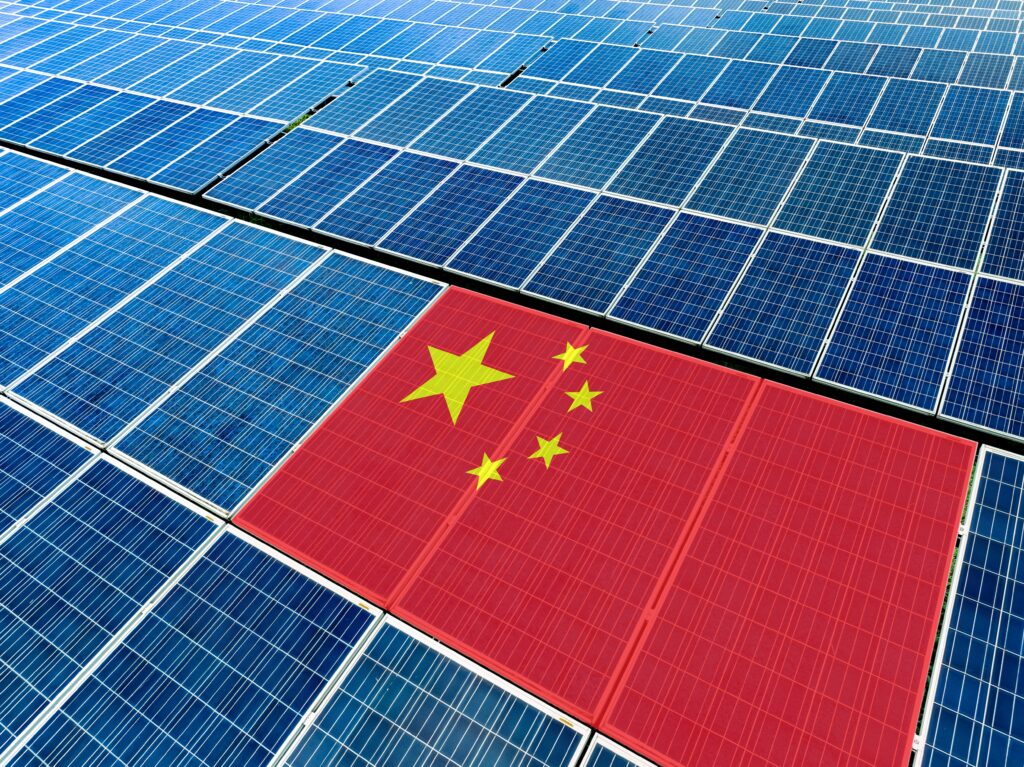
Credits: Fahroni | Shutterstock, All rights deserved.
By the COP30 climate summit in Belém, it had become evident: China is streaking past the United States and European Union in terms of clean energy technology and its industries. China is rolling out more than twice as much renewable capacity (solar and wind) than the rest of the world combined. As a result, China’s carbon emissions have recently plateaued and are expected to begin falling – while those worldwide climbed to record highs.
China’s success is not attributable to international summits or moralistic browbeatings but to hard-boiled self-interest, most importantly the comparative advantage of renewables at scale. Clean energy from the sun and wind is the cheapest energy anywhere, and clean tech produced en masse is affordable everywhere.
‘China recognizes that the whole system has to be reconfigured,’ Muyi Yang, an analyst at Ember, a global energy think tank, told me. ‘China has broken with the fossil-fuel model of development, even though its economy is full of challenges too, like many in the world right now. But it sees a new kind of development based on environmental stability.’
Over the last decade, China has cut emissions at home and abroad through its export of clean energy technology, thus enabling other countries to adopt cleaner energy solutions more quickly, reports the Centre for Research on Energy and Clean Air (CRECA), a Helsinki-based think tank. China’s current renewables numbers are outpacing many of its own targets, and will leave the EU, long the global valedictorian in climate protection, behind. Its secret is the same kind of incentives and policies that Germany and other Europeans put into law in the 2000s, when they led the world in innovation and renewables growth.
‘China is the reason why the battle against global warming appears more winnable than ever before,’ opines Jonas Waack of the Tageszeitung, a German daily. ‘At the centre of the world’s decarbonization now stands China, and not because ever more governments want to protect the climate but rather because there is no more secure route to prosperity.’
China’s solar production has increased 14-fold in a decade and now dominates the global market. It installs the wind-and-solar equivalent of five large nuclear power stations per week. In 2024, China added four times as much solar generation to its supply than the EU, and six times as much wind power. China raced past its own 2030 targets six years ahead of schedule by installing an enormous 1,200 GW of wind and solar capacity in 2024, as well as exceeding other expectations, such as in sustainable forest management. By 2030, renewables will constitute 18 percent of its energy consumption: far beyond the US, which is moving in reverse, but still behind the EU, which has already surpassed 25 percent of renewable energy share in 2024.
China still depends on fossil fuels – it leads the world in coal consumption – but its demand for gasoline, diesel and jet fuel levelled out last year. China’s reliance on these fuels was actually 2.5 per cent below 2021 levels, according the International Energy Agency (IEA). The IEA attributes this phenomenon to ‘structural shifts’ such as electrification: China’s electrification rate of about 30 per cent of final energy use is significantly higher than the United States and European Union. Today, about half of car sales in China are electric, a result of domestic policies ranging from incentives to trade-in deals.
Moreover, and not least, China’s clean technology is handsomely generating revenue – capturing a market that Europe had hoped to rule. China owns around 86 per cent of worldwide module production and controls virtually the entire supply chain for certain essential components.
On the electric vehicle (EV) market, it is only slightly less dominant: was responsible for over 70 per cent of global EV production in 2024. With its wealth of rare earth metals, an important component of battery storage, it is also out in front there, as well as in technology for producing low-emission hydrogen. Moreover, China invests heavily in clean energy projects in more than 50 countries, bringing the energy transition to the rest of the world.
China’s advances are especially good news, because China is the world’s biggest emitter of carbon gases – and by some considerable distance: the country is responsible for 90 per cent of the growth in CO2 emissions since 2015. Today, its share of total emissions is 32 per cent, far ahead of the US (13 per cent), India (8 per cent) and the EU at 6 per cent.
China’s investment in a future with renewables at its centre has more than one motivation, according to Belinda Schäpe of CRECA. Yes, the financials are very important, she admits: 10 per cent of China’s gross domestic product stems from its clean tech sector, and this could double soon. But energy security also plays a role. China is still a major importer of fossil fuels, including crude oil, coal and fossil gas. Russia is among its top oil suppliers. But, she argues, the environmental calculations aren’t just window dressing: heatwaves and floods are battering China and its urban centres are drowning in air pollution.
China, though out in front, could act more like the ‘defender of international cooperation on climate change’ that it recently boasted to be. It is still investing heavily in coal. Its oil demand for petrochemicals (not for combustion purposes) is increasing, too. Its emissions are more than twice those of the United States. It has not abandoned a growth-oriented economic model. And the 2035 targets of the world’s largest emitter of greenhouse gases are ridiculously conservative: just 7 to 10 per cent reduction from peak emissions when a 30 per cent drop is called for to meet the Paris goals. Beijing’s 2060 net-zero goal, for example, is unambitious and uninspiring (Germany’s is 2045), and it falls far short of what is required to avert climate catastrophe.
China, in many ways, is not a country that deserves emulation. But it has obviously considered the now vast research and experience available, and concluded that it has more to gain than lose in the transformation of its economy. Europe and the United States have forfeited the lead in reshaping the world’s energy supply. This augurs ill for the future of liberal democracy.
The views and opinions in this article do not necessarily reflect those of the Heinrich-Böll-Stiftung European Union | Global Dialogue.