








































































No recent US administration has gone as far as the current one in trying to put the US nuclear sector back on its feet again. President Trump has made nuclear energy a top priority and pursued an aggressive, hands-on programme to accelerate deployment of advanced reactors, build domestic fuel capability and reshape the institutions that license and oversee the industry. But all of this and billions in subsidies are unlikely to revive the moribund industry. Paul Hockenos reports.
Credits: SkazovD | Shutterstock, All rights deserved.
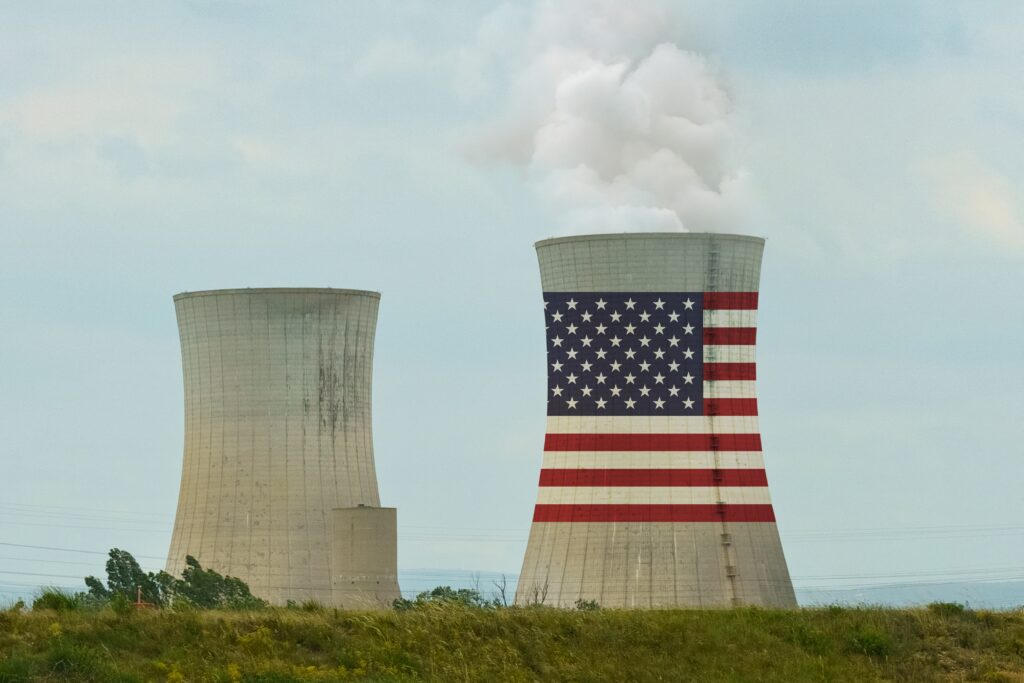
The potential of nuclear power is one of the few things that US politicians on both sides of the aisle agree upon. President Trump’s ongoing campaign to revive the atomic energy industry is more activist than his first-term attempt (2017–2020) – or those of the Obama and Biden administrations. But the result is very likely going to be the same: nada. There has been only one new nuclear reactor conceived and finished – online and producing energy – in the US during the last 40 years.
This is not because anti-nuclear activists – or experts either – cry that they are too dangerous, but rather because they are too expensive. Nobody wants to pay for them when renewables are so much cheaper, faster to roll out, safer and less toxic. This, however, hasn’t stopped US American investors from pouring money into an array of start-up projects – though not yet enough to actually make them happen.
Donald Trump says that nuclear power is ‘more American’ than wind and solar. The White House target is to grow US nuclear capacity from roughly 100 GW today to as much as 400 GW by 2050.
While he has gutted the Biden administration’s low-emissions energy package, known as the Inflation Reduction Act (IRA), he has not touched its nuclear provisions – but rather added to them. In May 2025, the White House laid out a multi-agency strategy: reform the Nuclear Regulatory Commission (NRC), fast-track reactor testing and demonstration, strengthen domestic fuel production, mobilize federal loan and guarantee authorities, and use federal lands and facilities to site reactors.
The by far largest (promised) outlay is the enormous USD 80 billion pledged to the US company Westinghouse, Cameco, and Brookfield, a global nuclear energy company, to build new nuclear reactors using Westinghouse AP1000 technology. It is a strategic partnership that will involve profit-sharing. The government would help with financing and regulatory approvals, and in return receive 20 per cent of future cash distributions from Westinghouse above a certain threshold. The exact amount that this deal entails depends on how much investment the company can raise, so it’s not a lump sum – nor is it a done deal.
The Westinghouse AP1000 model, a pressurized water reactor, is not an unknown entity. It was supposed to be the backbone of a nuclear renaissance in the 2000s, but flopped resoundingly. The only two units built in the recent past were Westinghouse AP1000s: by the Alvin W. Vogtle Electric Generating Plant in Waynesboro, Georgia (near Augusta). In the process of construction, their cost of about USD 35 billion exceeded original projections by a whopping USD 20 billion. And it took twice as long as originally planned to complete. In the process, Westinghouse went bust and filed for bankruptcy, and another company took over to finish the job. Since then, Westinghouse has not attempted to build another – and most experts, even those who support nuclear energy, see the AP1000s as prehistoric dinosaurs.
The New York Times noted that the Trump administration and Westinghouse have provided few details about their plans. ‘The USD 80 billion is intended to absorb the excess cost of nuclear,’ Mark Cooper, an economic analyst at the Institute for Energy and the Environment at the Vermont Law and Graduate School, told the New York Times. ‘Westinghouse has to find a buyer. There are no buyers at the current price. They still don’t recognize that wind and solar are much cheaper.’
Perhaps, argue nuclear advocates, getting a defunct reactor back in operation is easier than building anew. The federal government is loaning Holtec International USD 2.8 billion to revive the Palisades nuclear plant in Michigan, which was retired in 2022. Three Mile Island Unit 1 is also on the list of ‘zombie reactors’, as Power magazine calls them. These reactors were not shut down for safety reasons but rather because they didn’t make a profit. No one is talking about a business model that will rectify that.
Small modular reactors (SMRs)
In Europe earlier this year, US energy secretary Chris Wright said that small modular reactors are the way to go. He called nuclear a ‘high value energy’ that functions 24/7 and produces high process heat for industrial activities (renewables are ‘low value’ because they are dependent on the weather). ‘The idea for next generation nuclear is to build it in a factory and assemble it quickly,’ said Wright. ‘The first [SMRs] won’t be cheap, but if we build them in volume, they can become cheap.’
The Trump administration wants to pave the way for SMRs, supposedly the next generation of reactors. One means to this end is slashing the ‘red tape’ that has made nuclear rollout so difficult to make happen. It has ordered a ‘total and complete reform’ of the NRC that includes a maximum 18-month deadline for reactor construction and operation licenses, as well as streamlining public hearings, simplifying design reviews and focusing on credible risks rather than overly conservative radiation-exposure models.
It is unlikely that all of this ‘bureaucracy’ slashing will really bring SMEs to life – and thus far they are nothing more than plans, theories, wishes and fantasy, rather than real or existing things. The country that seems to be furthest along is Canada, where the government has put forward USD 2.1billion for four modular reactors (BWRX-300 design created by GE Hitachi Nuclear Energy) that together will have about the capacity of one AP1000.
These vague plans of the Trump administration are now in the air but with no mention, for example, of nuclear waste. More than 95,000 metric tons of spent nuclear fuel is temporarily stockpiled in special water-filled pools or dry casks at 79 sites in 39 states. The US is no closer to finding a full-time repository than it was three decades ago.
Meanwhile, the Department of Energy is attempting to strengthen domestic supply chains for nuclear fuel. This autumn, it started a new pilot programme involving four companies to build advanced nuclear fuel lines. The programme will ‘expand access to the advanced fuel required to test [reactor] designs and accelerate the transition from demonstration to deployment’. The idea is that development of these pilot projects could drive private sector investment and create a fast-track approach to commercial licensing.
Thus far, the kind of SMR that the US administration, the nuclear power lobby and various governments across the world are in favour of hasn’t been built yet – not one. And why should it happen when renewables are a fraction of the price, super-fast to roll out, safe and non-toxic?
The views and opinions in this article do not necessarily reflect those of the Heinrich-Böll-Stiftung European Union | Global Dialogue.