









































































The electrical interconnection between Crete and mainland Greece was completed and has been in operation since May 2025. The completion of this infrastructure project is a big step in Greece’s energy transition. Connecting the island of Crete with the mainland allows the country to finally tap into the abundant wind and solar energy potential on Crete and to switch off old and polluting power plants. At the same time, the Ariadne interconnection builds the foundation for advancing green energy in the Eastern Mediterranean. Daniel Argyropoulos reports.
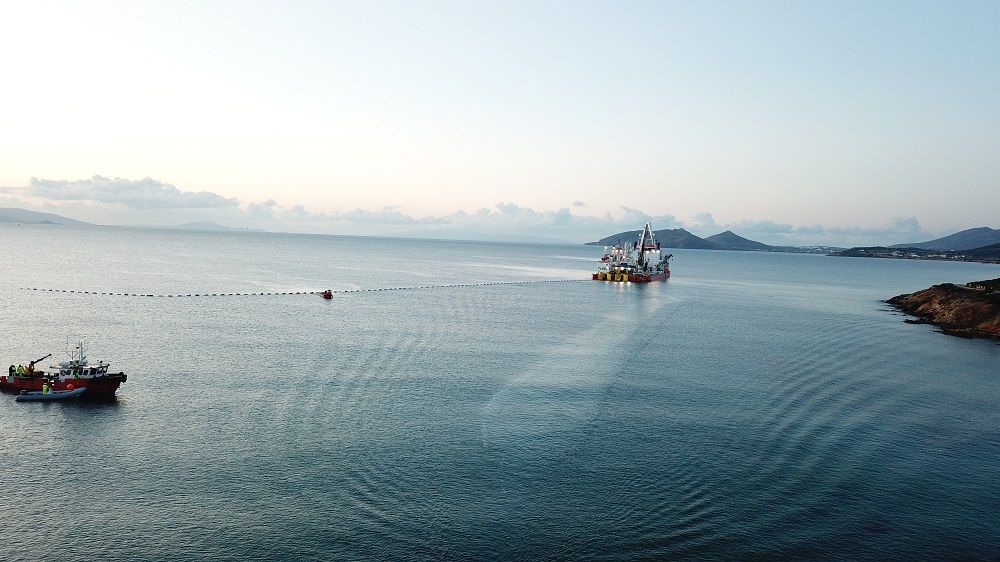
Credits: Ariadne Interconnection.
In Greek mythology, Ariadne, daughter of the Cretan king Minos, gave Theseus a sword, so he could fight against the Minotaur, and a long, rolled-up string. Theseus went off to Crete and killed the Minotaur hidden in a labyrinth. After defeating the beast, Theseus used the string to find his way out of the labyrinth. Ever since, Ariadne’s string has been a metaphor for finding a way out of a difficult situation.
Ariadne’s string, in modern times, is not made out of wool but out of copper, and spans the Aegean Sea over a length of 335 kilometres. The Ariadne interconnection is a new power transmission line that connects Attica on mainland Greece and the island of Crete. It was completed at the end of 2024 after three years of construction and has been in operation since the end of May 2025.
Building the interconnection was technically complex and challenging. Two cables had to be placed at depths of up to 1,200 metres into the rocky seabed of the Aegean Sea. According to the developing company, it is one of the deepest interconnections worldwide. When in full operation, it will be able to transmit 1,000 MW of electrical power, enough to cover the energy needs of the whole island during most of the year.
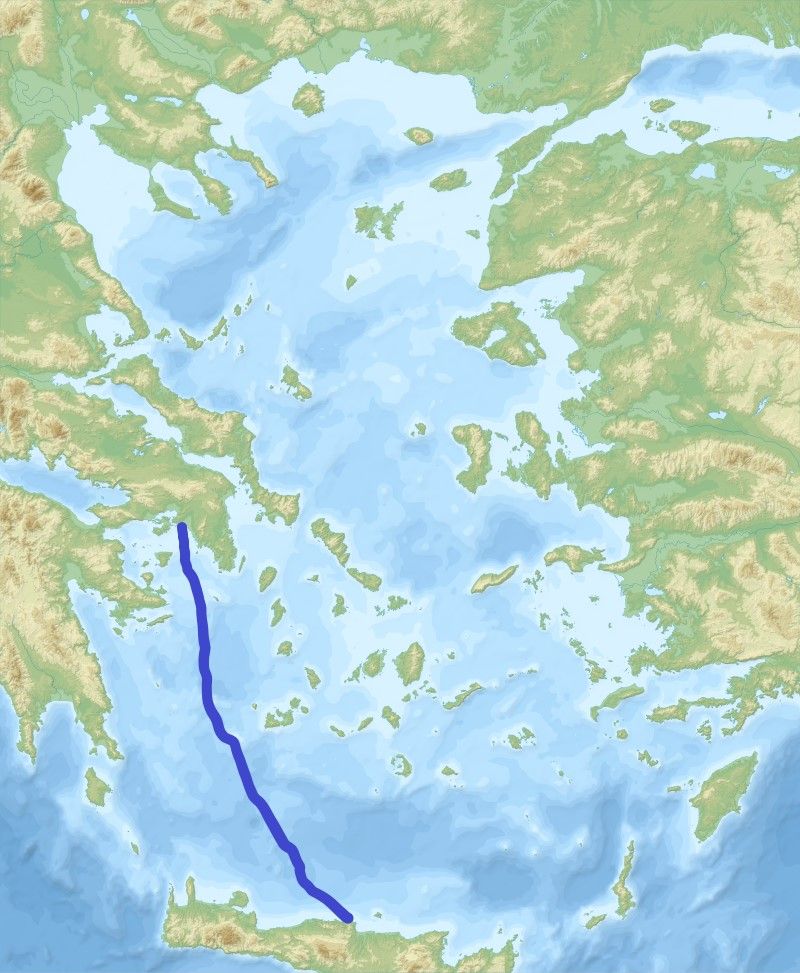
Map of the Ariadne interconnection. Credits: Eric Gaba – Sting | Wikimedia Commons, Public Domain. Own design.
A milestone for the energy transition
The Ariadne interconnection, in addition to a smaller interconnection between Crete and the Peloponnese completed in 2022, is a major milestone in the energy transition of Greece. Up until recently, the electrical system of Crete was isolated, meaning that all energy used by the 650,000 inhabitants of Crete and the roughly 5 million tourists visiting the island every year had to be generated on the island. A large part thereof is still produced from old and inefficient power plants burning heavy oil and diesel. This not only leads to high CO2 emissions but also to very high generation costs.
These costs are passed on to all electricity consumers in Greece through a Public Service Obligation (PSO), which is set by the government and is part of the utility bill. As consumers on the non-interconnected islands (NII) are not charged higher tariffs than consumers on the mainland, the PSO is used to subsidise the much higher production costs in the islands. The total amount collected through the PSO is around €600-700 million per year. At the household level, the PSO typically accounts for 4-8% of a typical household’s electricity bill, depending on the amount of electricity consumed.
In Crete’s isolated electrical system, there was only little space for renewable energies, despite the impressive solar and wind potential. Renewable energy, in theory, could supply a large share of the energy needed on the island. But as wind and solar are variable sources of energy by their nature, their integration is tricky in an isolated electricity grid. Flexible back-up generation is necessary to meet demand for energy when there is little wind or sun. The existing stock of old power plants was only able to do this to a limited extent.
As a consequence of this technical limitation, as of today, the share of renewable energy in the electricity supply of Crete is limited to 20%, with the remaining 80% being produced from fossil fuel. In comparison, the share of electricity produced from wind energy, solar PV and hydropower in the entire country had already reached 50% in 2024, up from about 20% in 2015, mainly due to the strong development of wind energy and solar PV in recent years.
Connecting Crete with the much larger mainland electricity system finally ends the stalemate. Back-up capacity is no longer needed on the island as flexible power plants on mainland Greece can cover the demand in the future. With the interconnection in operation, the old power plants can be gradually shut down, reducing the carbon footprint of Crete by up to 500,000 tonnes of CO2 annually, as calculated by the developing company.
Also, the country’s consumers are expected to collectively save millions of euros every year as a significant share of the PSO is allocated to Crete. In 2020, Crete, as the largest island, accounted for about 20% of the total power consumption among the NIIs. When all old power plants are shut down, the savings from avoided PSO payments will amount to €100-150 million per year. At the same time, the use of wind and solar PV can be ramped up, providing clean and much cheaper energy to the island, and even mainland Greece.
Connecting islands to the grid is costly and might not be economically viable in the case of islands with a much smaller population. Many of these isolated islands exist in the Aegean Sea and elsewhere. In these cases, other options to integrate renewable energy are being explored and increasingly implemented. The use of battery storage, in particular, is becoming more and more cost efficient. This has led to the implementation of hybrid systems consisting of solar PV and wind turbines combined with battery storage. These hybrid systems, which have been implemented on several remote islands, are able to replace a large part of the power produced from diesel generators.
Extending Ariadne’s string even further
An interconnection between Greece, Cyprus and potentially Israel has been discussed for many years, and political agreements were signed by Greece and Cyprus. However, the project has not advanced so far. The successful completion of the Ariadne interconnection could create new momentum to the project known as the Mediterranean Interconnector.
Extending the connection to Cyprus would help Cyprus to secure its energy supply and to dramatically lower its carbon footprint as the dependency on fossils fuels, all of which have to be imported, is even higher than on Crete.
The modern version of Ariadne’s string has helped to find a way to open up a green energy future for Crete. It can be hoped that the idea of Ariadne’s mythical string is extended to a web that helps connect those islands still isolated today.
The views and opinions in this article do not necessarily reflect those of the Heinrich-Böll-Stiftung European Union.