










































































Nuclear installations undermine Ukraine’s security because it is particularly vulnerable to drone and artillery attacks. Yet Kyiv wants more of it, despite the fact that so much speaks for renewables to replace damaged conventional energy facilities. Paul Hockenos reports.
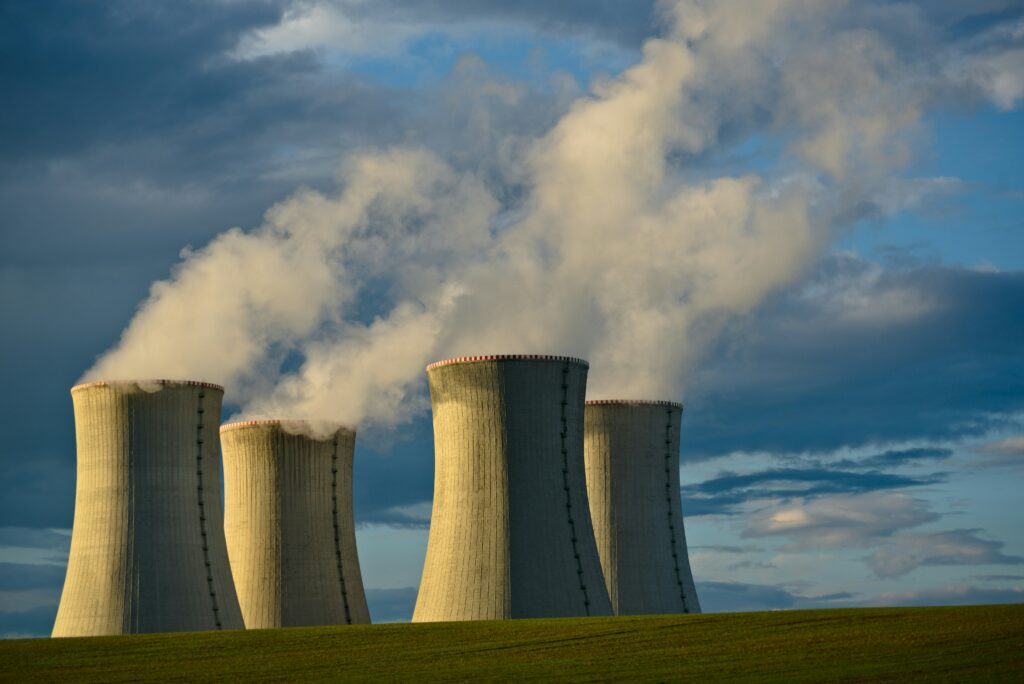
Credits: Lukáš Lehotský | Unsplash, Public domain.
Since the full invasion of Ukraine three years ago, the country’s 15 nuclear reactors – six currently under Russian military control but operated by Ukrainian staff – have been targets of relentless Russian shelling. On 14 February 2025, one Russian drone, with a high-explosive warhead, punched a hole in the protective outer shell of Ukraine’s shuttered Chernobyl nuclear plant and started a fire (no radiation was leaked). Ukraine’s leadership and the International Atomic Energy Agency, an agency promoting nuclear energy, have been vociferous about the gravity of the threat posed to existing reactors.
Of course, Ukraine is a country that understands nuclear power (and its dangers): only France and Slovakia rely more on the splitting of atoms for energy. And thus it might be understandable that Ukraine’s old-school energy elite – products of Soviet-era thinking – believe that only more will compensate Ukraine’s damaged fossil fuel and hydroelectric plants, which have left people freezing in mid-winter. Ukrainian president Volodymyr Zelensky calls nuclear energy expansion a ‘key to energy independence’.
This is why Ukraine’s state-owned nuclear utility Energoatom sought out the US company Westinghouse to build nine pressurised water reactors at established nuclear power sites. There are no public estimates for the entire deal, but by the measure of the two 2023-completed AP1000 reactors in Vogtle, Georgia, nine similar newly built entire nuclear power plants would run up a bill of $158 billion (although as three reactors are already under construction at the Khmelnytskyi Nuclear Power Plant in western Ukraine, this figure might be lower). And just this year in February, Ukraine looked into purchasing two Russian-made reactors from Bulgaria for $600 million.
Nuclear power is a dead end for Ukraine
Ukraine’s pursuit of more nuclear energy is fundamentally wrongheaded and its desperate attempt to do so on the cheap is doomed to fail. This is not the same fool’s errand that other countries are pursuing – a global ‘nuclear energy renaissance’ is supposedly in progress – but a self-inflicted wound that will compromise the country’s defence, and therefore its very existence. Among others, security experts from the European Commission argue that it is solar and wind parks, not new nuclear facilities, that bolster energy security and geosecurity. The buildout of decentralised renewables and integration into the EU energy system, the EU claims, is the quickest way to stabilise Ukraine’s decimated energy system and the best protection against Russian efforts to incapacitate it further.
Why?
Firstly, the price of new nuclear energy is exorbitant, which is why there is not a single reactor of any kind currently being built in all of South and North America. Neither states nor private financiers are willing to front the billions required to build them. Original cost estimates of nuclear plants tend to double and even triple by the date of their completion, if they are completed at all and not abandoned, as one in nine have been. And compared to onshore wind and solar parks, nuclear power per kilowatt is at least three times as pricey. Furthermore, in contrast to renewables, whose cost has nosedived, nuclear power has become increasingly expensive.
Of course, Ukraine is counting on foreign donors to come up with the funding, although no promises to do so have come yet – and most probably never will. The investment is much too risky, which is why in Ukraine, the EU has opted to back ‘a massive acceleration of domestic renewable power production’. Moreover, regardless of who bankrolls it, surely these huge sums are better spent on renewables (if they offer three times the bang for the buck), gas plants and repairing the grid, or the military hardware Ukraine needs to defend itself.
Secondly, the developers’ rosy projections of nuclear plant construction schedules usually range from five to eight years – but always take longer, sometimes twice or three times as long. The Vogtle reactors in the US, estimated to be built in five years, took ten and were $17 billion over cost. Construction costs for Hinkley in the UK have ballooned from £18bn to £46bn. Thus new nuclear power is not the quick-as-possible fix that Ukraine desperately needs, even given the lowest-end estimates.
Ukraine’s manoeuvre to cut costs and buildout time is the purchase of partially constructed reactors that the US firm Westinghouse and the Bulgarian state had mothballed years ago. But if the sales go through, neither time nor money will be saved. The two Westinghouse AP1000s have idled in a warehouse since 2017, when two South Carolina utilities bailed on the project that, due to manufacturing errors and incompetence, had more than doubled in projected cost; they forfeited the $9 billion spent, which constituted the largest business failure in the history of South Carolina. Westinghouse declared bankruptcy and two utility executives were sentenced to jail.
Decentralised renewable energy
The Ukrainians’ interests would be far better served investing in solar and wind parks, smart grid, and storage systems, a case made by no organisation more convincingly than the Ukrainian NGO Razom We Stand. Investors worldwide sunk over $2 trillion into zero-carbon technology last year, compared to just $80 billion in nuclear technology. Energy investors obviously know a deal when they see it, and renewables farms can be up and running within about a year after their approval.
Also, security experts have begun to take note of renewables’ value. Unlike conventional energy generation, renewable energy is by its nature decentralised and distributed: that is, its production is local and close to the point of consumption, and performed by a variety of small, grid-connected or distribution system–connected devices. Clean energy technologies should be spread throughout the country to deprive Russia of the ability to knock out large amounts of power capacity with one strike.
The views and opinions in this article do not necessarily reflect those of the Heinrich-Böll-Stiftung European Union.